Metric documentation of cultural heritage provides reference points for preservation and in some cases, reconstruction of built heritage. Although the documentation process is traditionally done using 2D maps, drawings, and photographs, modern techniques nowadays tend to use 3D digital technologies such as laser scanning and photogrammetry. Novel neural radiance fields-based methods show great promise in supporting this task, first with the Neural Radiance Fields (NeRF) and later on using the more explicit 3D Gaussian splatting (3DGS) methods which is the subject of this research. While previous other studies have proven this point, it still remains to be seen if radiance fields methods such as 3DGS can provide a similar quality, both visual and geometric, to conventional methods. This is particularly important for heritage documentation applications. This project aims, therefore, to investigate the application of 3DGS for heritage documentation in terms of metric quality.
Collaborators
Hélène Macher (ICube TRIO)
Etienne Sommer (ICube TRIO)
Kadek Ananta Satriadi (Monash University)
Francesca Matrone (Politecnico di Torino)
Related publications
IEEE Xplore
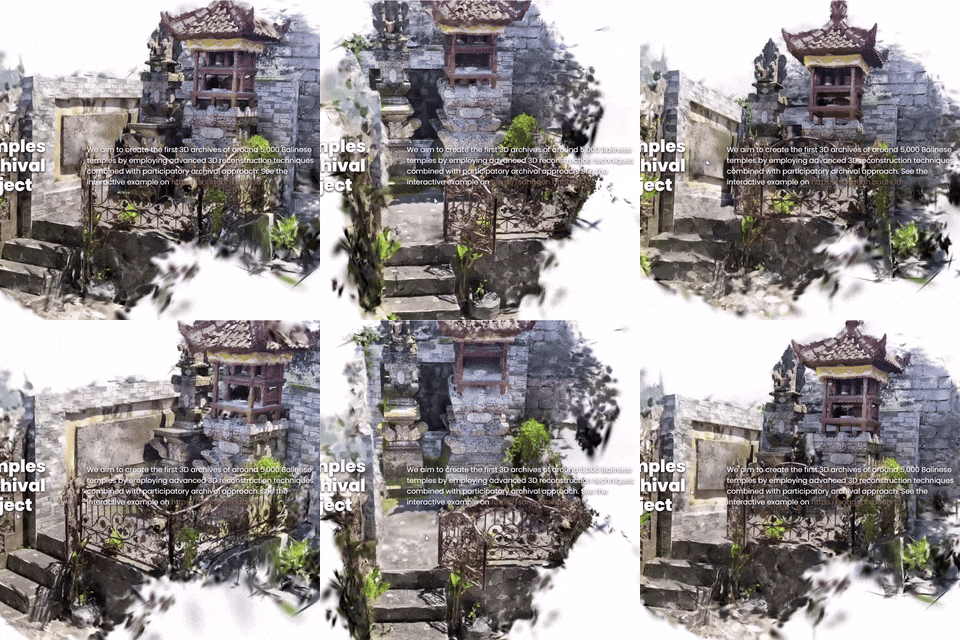
3D Gaussian Splatting for Archival of Balinese Temples from Community-Sourced Videos
A. Wilson, A. Murtiyoso, B. Jenny, and 5 more authors
In 2025 IEEE International Conference on Imaging Systems and Techniques (IST), 2025
We present a novel application of 3D Gaussian Splatting (3DGS) for the large-scale archival of thousands of temples in Bali. Our project, the Bali Digital Heritage Initiative, adopts a participatory approach in which local communities collect video footage of these vulnerable temples, which we transform into 3DGS scenes to serve as digital archives. Unlike existing approaches that require uploading curated sets of images, video contribution simplifies the process for the community. We expect this to encourage a high participation rate and increase the number of archived temples. However, these community-sourced videos are often of variable quality and usually aren’t ideal for 3D reconstruction, introducing technical challenges. This paper first presents several key challenges in the development of the 3DGS pipeline in this context, including managing video quality, combining multiple videos, ensuring reliable results from Structure from Motion, and maintaining the visual quality of 3DGS scenes. We then propose and test solutions to many of these challenges, addressing all parts of the reconstruction pipeline. We also introduce a postprocessing stage that cleans up the scene through a series of purpose-built 3DGS filters, which consider attributes of Gaussian primitives, including local density, geometry, and colors. Finally, we discuss future research directions to address unsolved problems and improve the performance of the pipeline.
@inproceedings{wilson20253d,title={3D Gaussian Splatting for Archival of Balinese Temples from Community-Sourced Videos},author={Wilson, A. and Murtiyoso, A. and Jenny, B. and Darmawiguna, I.G.M. and Suputra, P.H. and Chandler, T. and Kesiman, M.W.A. and Satriadi, K.A.},booktitle={2025 IEEE International Conference on Imaging Systems and Techniques (IST)},pages={1--6},year={2025},doi={10.1109/IST66504.2025.11268436},dimensions={true},publisher={IEEE},project={GS3D}}
IEEE Xplore
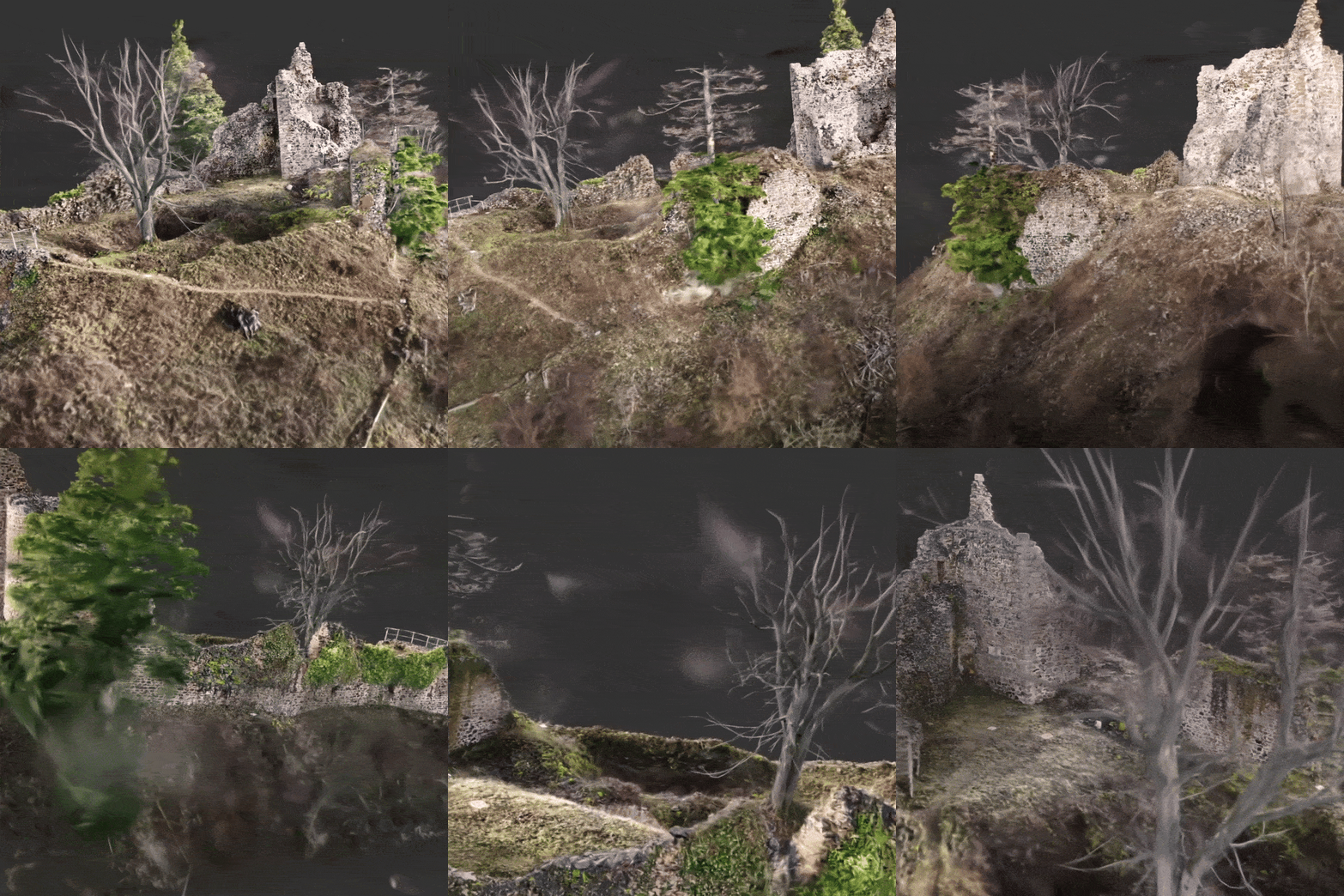
Radiance Fields for Archaeological Documentation of Medieval Rhine Valley Castle Ruins
E. Sommer, A. Murtiyoso, M. Koehl, and 1 more author
In 2025 IEEE International Conference on Imaging Systems and Techniques (IST), 2025
This study investigates the use of Gaussian Splatting for 3D reconstruction of medieval castle ruins in the Rhine Valley, comparing its effectiveness with conventional photogrammetry. 3D Gaussian Splatting (3DGS), a recent real-time rendering technique, models scenes using point-based representations with anisotropic Gaussians, enabling high-fidelity reconstructions from sparse image inputs. Unlike traditional photogrammetry, which depends on dense point clouds and mesh generation, 3DGS offers smoother rendering, better handling of fine details, and improved performance in visually complex or degraded areas. 3DGS excels in producing visually compelling, immersive models with fewer artifacts in occluded or texture-deficient regions. In this paper, three analyses were performed by focusing on three individual aspects: processing time, geometric accuracy, and visual quality. Our study’s results highlight the advantages of 3DGS in this regard, which include quick data processing time and excellent visualisation capability specifically with finely detailed objects. However, this method still faces challenges when employed for a metric archiving of built heritage, where traditional photogrammetry still provides a higher quality metric result using the same input data. 3DGS suffers particularly from noisy data, especially when converted into point clouds. Nevertheless, this approach presents a promising tool for digital heritage preservation, enabling efficient and realistic visualisation of fragile historical sites.
@inproceedings{sommer2025radiance,title={Radiance Fields for Archaeological Documentation of Medieval Rhine Valley Castle Ruins},author={Sommer, E. and Murtiyoso, A. and Koehl, M. and Grussenmeyer, P.},booktitle={2025 IEEE International Conference on Imaging Systems and Techniques (IST)},pages={1--6},year={2025},doi={10.1109/IST66504.2025.11268408},dimensions={true},publisher={IEEE},project={GS3D}}
ISPRS Archives
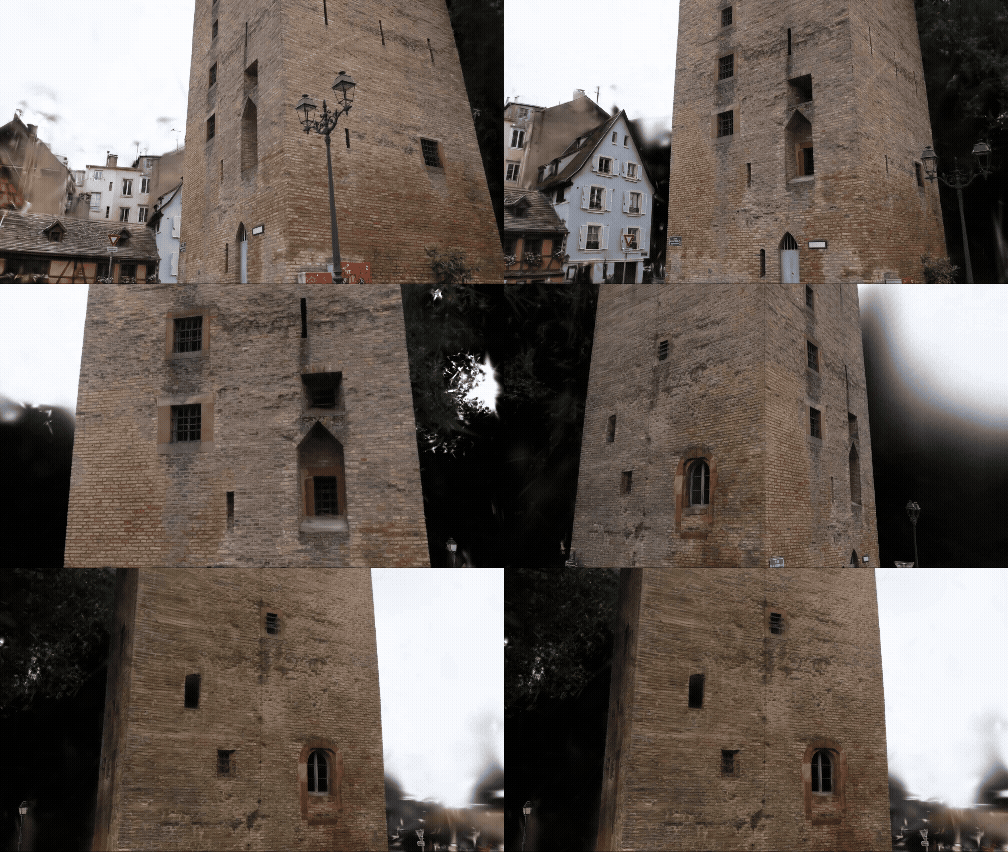
Gaussian Splatting for Facade Orthophoto Generation – Comparison with MVS and TLS
A. Murtiyoso and H. Macher
The International Archives of the Photogrammetry, Remote Sensing and Spatial Information Sciences, 2025
The notion of radiance fields is a very recent topic which has gained much traction in the past couple of years. Among some of the well known techniques, 3D Gaussian splatting (3DGS) seems to generate promising results in terms of 3D reconstruction. In the domain of heritage documentation, orthophotos are a standard product usually generated from photogrammetry by projecting image pixels into a 3D surface created from depth maps or point clouds. In this paper we investigate the possibility to substitute the conventional method for 3D surface generation, either terrestrial laser scanning (TLS) or multi-view stereo (MVS), with 3DGS. The paper will attempt to answer two questions: (1) whether this novel method is a viable solution for orthophoto generation within the heritage documentation context, and (2) at what point is 3DGS worth the time and effort to reach an acceptable orthophoto when compared to conventional methods. To do this, we perform multiple analysis on both the geometric quality of point clouds and the orthophotos themselves, using conventional TLS data as our reference. Our results indicate that 3DGS is not only promising, but indeed a viable alternative to conventional MVS with a potential gain of processing time between 12% up to 33% to reach a comparable quality. In the scenarios tested, both of these gains came with an average point cloud standard deviation of 2 cm.
@article{isprs-archives-XLVIII-M-9-2025-1059-2025,author={Murtiyoso, A. and Macher, H.},title={Gaussian Splatting for Facade Orthophoto Generation – Comparison with MVS and TLS},journal={The International Archives of the Photogrammetry, Remote Sensing and Spatial Information Sciences},volume={XLVIII-M-9-2025},year={2025},pages={1059--1064},doi={10.5194/isprs-archives-XLVIII-M-9-2025-1059-2025},dimensions={true},publisher={Copernicus},project={GS3D},}
ISPRS Archives
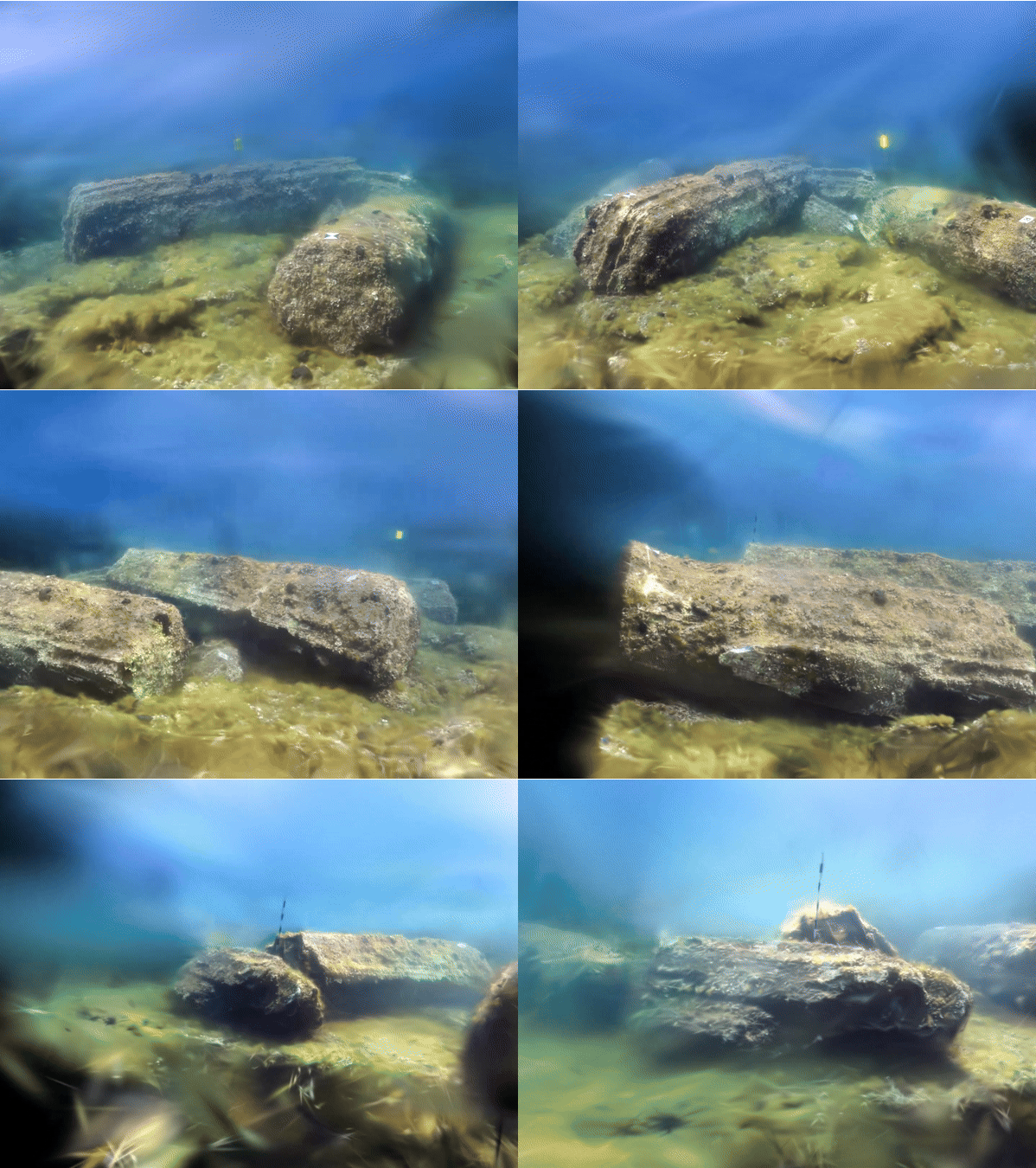
Initial Experiments on the Use of Radiance Fields for Underwater 3D Reconstruction
B. Tanduo, F. Matrone, and A. Murtiyoso
The International Archives of the Photogrammetry, Remote Sensing and Spatial Information Sciences, 2025
Underwater photogrammetry presents unique challenges, including light attenuation, refraction, and turbidity, that affect the accuracy and quality of 3D reconstructions. This study investigates the performance of novel neural rendering techniques, Neural Radiance Fields (NeRF), SeaThru-NeRF, and 3D Gaussian Splatting (3DGS), in comparison to conventional Structure-from-Motion (SfM) workflows. Using a dataset acquired during the SIFET benchmark campaign on a submerged Roman archaeological site, we processed image data via Nerfacto, SeaThru, and Jawset Postshot (3DGS) and compared outputs against a reference model produced in Agisoft Metashape. Evaluation criteria included processing time, geometric accuracy (via M3C2 analysis), point cloud density and roughness, and point cloud completeness. Results show that radiance fields-based methods significantly reduce processing time while providing competitive visual results. SeaThru-NeRF demonstrated the highest geometric accuracy, benefiting from underwater-specific corrections, while 3DGS offered photorealistic rendering. These findings highlight the potential of neural methods for underwater cultural heritage documentation, though further improvements are needed in data fidelity and robustness under challenging underwater conditions.
@article{isprs-archives-XLVIII-M-9-2025-1475-2025,author={Tanduo, B. and Matrone, F. and Murtiyoso, A.},title={Initial Experiments on the Use of Radiance Fields for Underwater 3D Reconstruction},journal={The International Archives of the Photogrammetry, Remote Sensing and Spatial Information Sciences},volume={XLVIII-M-9-2025},year={2025},pages={1475--1481},doi={10.5194/isprs-archives-XLVIII-M-9-2025-1475-2025},dimensions={true},publisher={Copernicus},project={GS3D},}
ISPRS Archives
Comparison of state-of-the-art multi-view stereo solutions for close range heritage documentation
A. Murtiyoso, J.S. Markiewicz, A.K. Karwel, and 2 more authors
International Archives of the Photogrammetry, Remote Sensing and Spatial Information Sciences, 2024
In recent years novel 3D reconstruction methods have been developed to improve the conventional image-based point cloud generation techniques. These novel methods generally attempt to address various challenges encountered in conventional methods, namely, the reconstruction of reflective surfaces and the amount of processing time required, both of which are major bottlenecks in heritage documentation and especially those related to large and complex objects. In this paper, we identified three types of 3D image-based reconstruction techniques and tested their usage on heritage datasets, namely (1) conventional multi-view stereo (MVS), (2) learning-based MVS, and (3) neural radiance fields (NeRF). The aim of this study is to determine the capabilities of these methods in reconstruction of three different heritage-related datasets with different challenges. Our results show that conventional MVS is nowadays a reliable solution for 3D reconstruction, in many instances recording good results relative to the reference terrestrial laser scans (TLS) when properly deployed. When applied to a challenging highly reflective scene, conventional MVS fared well using the PatchMatch algorithm (reaching an object completeness rate of 99.05%), while NeRF’s best performance was 99.98%. However, NeRF suffered from noisy data, some of which may stem from its radiance field-to-point cloud conversion method. The results show that there is great potential in using specific methods for specific cases, and research in combining them may yield interesting results in the future.
@article{murtiyoso2024comparison,title={Comparison of state-of-the-art multi-view stereo solutions for close range heritage documentation},author={Murtiyoso, A. and Markiewicz, J.S. and Karwel, A.K. and Grussenmeyer, P. and Kot, P.},journal={International Archives of the Photogrammetry, Remote Sensing and Spatial Information Sciences},volume={48},number={2},pages={317--323},year={2024},doi={10.5194/isprs-archives-XLVIII-2-W4-2024-317-2024},dimensions={true},publisher={Copernicus},project={GS3D},}